

PreciseEquipment
www.preciseequip.com
- Joined
- 2012
- Posts
- 40
- Geo
- North America, USA
Greetings, today I would like to discuss options for safely moving and lifting a Polar 115 EMC Paper Cutter by forklift and demonstrate the easiest and safest way to move, load, or unload a large guillotine Polar 115 EMC paper cutter minimizing damage to the machine.
Always remember, if you do not have experience moving large and heavy pieces of equipment; call a professional to do it. We always recommend a professional rigging company that is bonded and insured. Different types of machines will require different ways to move and this tutorial may not be applicable to your specific machine. Do not attempt this by yourself we will not be held liable for anything you do by following our tutorials or demonstrations. Precise Equipment offers services for Rigging, Loading, Installation, Deinstallation, Support, and other Services. Contact us for more information at www.preciseequip.com | info@preciseequip.com | 714-991-0427.
The right equipment is critical!
When lifting a large cutter such as the 92 series and up, you will need a large capacity forklift. In this tutorial we used a 15,000 max capacity (big momma) caterpillar. Do not attempt to lift a piece of equipment that you are unsure of the approximate weight of the machine or your forklift max capacity isn't greater than the total weight of the machine.
What is needed:
1. Large Capacity Forklift (10,000 lbs or Greater)
2. One Large 4x4 Block (at least 5'ft in length)
3. Four 2x4's or 2x6's blocks (1'-2'ft each)
4. Prybar or Crowbar
Step One: Preparation
Prepare the cutter to be moved. Remove all loose items, disconnect and secure anything hanging such as power cables, observe the surrounding area and plot a clear path free from obstruction. You do not want to lift the machine over things, it is not safe and you will be fighting gravity. Always think safely and effectively.
Step Two: The back gauge
Always, when planning to move any guillotine cutter drive the back gauge all the way back at it's farthest outward position. This will ensure it is not damaged in the moving process and it allows much more room for the forks on the forklift to enter the machine ensuring proper weight distribution and balance.

Step Three: Secure and shim the clamp
To prevent damage to the clamp on the cutter, it is best to place a shim on the back part of the clam towards the top of it where there is a gap. You will need to use a prybar or a crowbar to lower it down (carefully) and try not to scratch or dent it in the process. Pry it downward just enough to place two blocks (2x4) on each side of the clamp. What this will do is secure the clamp and place a buffer between the clamp and the machine ensuring it does not slam or damage the machine when lifting with the forklift.
<photo will be added here to demonstrate this soon>
Step Four: Position the forklift
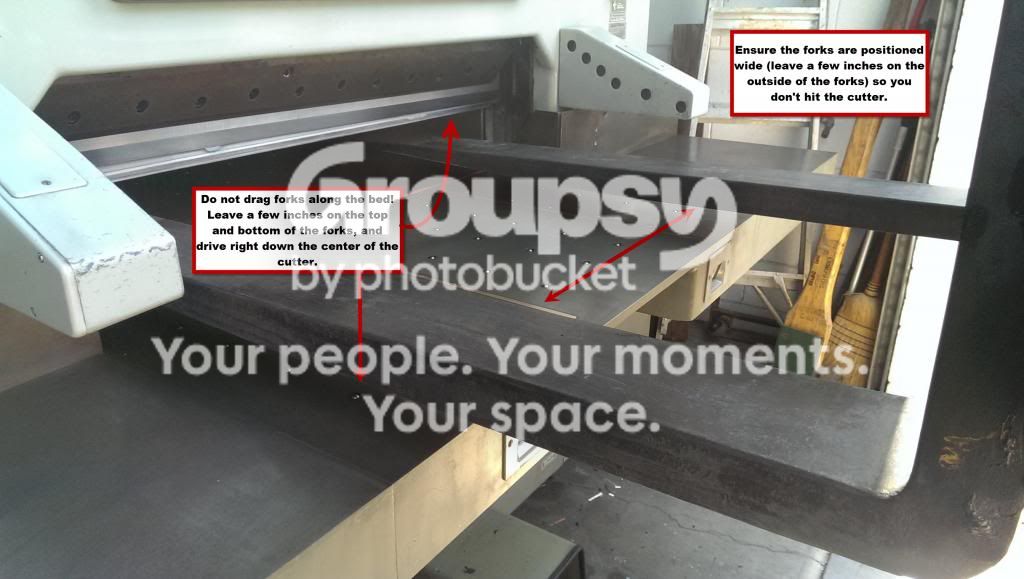
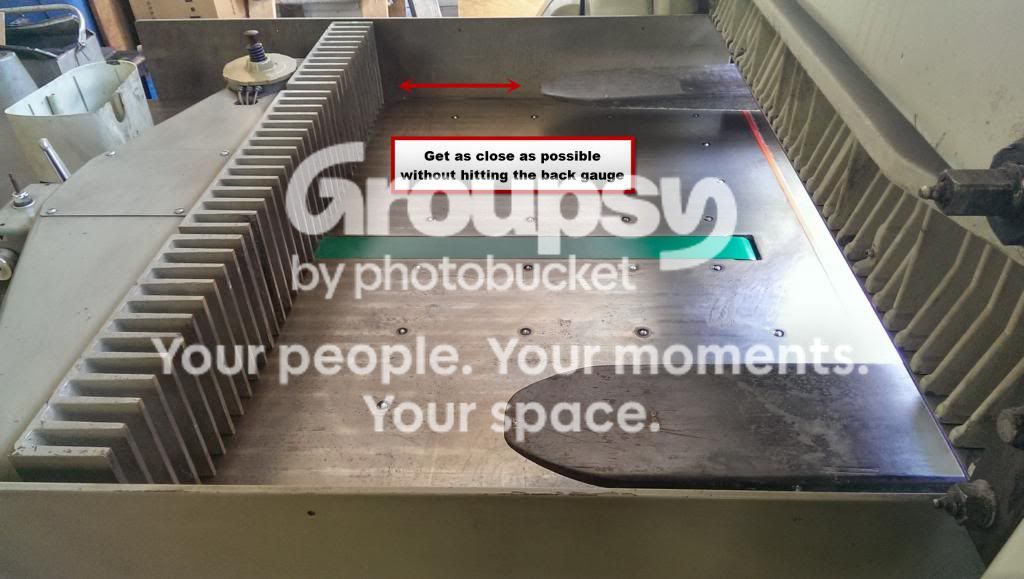
Open the forks to a wide position, leaving a few inches on the outside of the forks so they do not hit the sides. Drive the forklift down the center of the cutter. Make sure that you do not drag the forks along the bed of the cutter, hit the sides, top, or back gauge. Get as much bite on the forks as possible without hitting the cutter with the mast of the forklift. The closer you can get into the cutter, the more stable and safe it will be when lifting.
Do not hit the back gauge!
Step Five: Getting ready for lift off...
Once the forklift is in position, place a 2x4 or 2x6 on each fork underneath the clamp as illustrated in the diagram below. Center the blocks underneath the clamp evenly. This will lessen the chance of damaging the clamp and provide better grip and torque when lifting. Once the blocks are in place, slightly lift the forks and place the 4x4 board underneath the forks along the bed also as shown in the diagram below. This will enable the forklift to have a strong bite of the cutter and properly distribute the weight of the machine when lifted.
Place the 2x4 or 2x6 on the forks, centered underneath the clamp.

Lift or tilt the forks slightly and place the 4x4 along the bed.

Step Six: Lift off...
Begin to lift and tilt the forks as necessary to create a strong downward force on the large 4x4 and the clamp blocks, and begin to lift the cutter carefully and slowly, tilting back towards the forklift. If the cutter is on legs, be prepared to move them out of the way once the cutter is off the ground. (Always keep your eyes on the machine! especially when near a very heavy piece of machinery that is off the ground!)

Take the machine just a few inches (3" - 6" inches) off the ground and slowly move the cutter as needed and watching the distances from objects or walls when maneuvering. Take it slow and do not lift the cutter higher than necessary, gravity will always work against you.
Final Tips:
If the cutter is being transported or loaded onto a truck, never put it down on it's legs, It will crack the frame from the vibration and bouncing during transit. Instead, make a sturdy crate or stack several pallets underneath the frame in the back to support the rear side of the cutter (as shown in the photo below).

If the cutter has an air bed, the pump should be placed and secured to the rear bed of the cutter or placed on it's own pallet. The side tables can also be removed and placed on a pallet for transportation.
We prefer loading these type of cutters on flatbeds and tarp wrapped. Side loading them can be done quickly and effectively. If you load these into a container however, you might have to remove the side shroud that covers the motor. We have found that it will fit with a few inches to spare on each side, and it should be the last item placed at the door.
This concludes my lesson for loading a large Polar Paper Cutter. Please feel free to add your comments and ideas on other methods. If you find this helpful, please vote the thread up at the very top. Thank you.
Always remember, if you do not have experience moving large and heavy pieces of equipment; call a professional to do it. We always recommend a professional rigging company that is bonded and insured. Different types of machines will require different ways to move and this tutorial may not be applicable to your specific machine. Do not attempt this by yourself we will not be held liable for anything you do by following our tutorials or demonstrations. Precise Equipment offers services for Rigging, Loading, Installation, Deinstallation, Support, and other Services. Contact us for more information at www.preciseequip.com | info@preciseequip.com | 714-991-0427.
The right equipment is critical!
When lifting a large cutter such as the 92 series and up, you will need a large capacity forklift. In this tutorial we used a 15,000 max capacity (big momma) caterpillar. Do not attempt to lift a piece of equipment that you are unsure of the approximate weight of the machine or your forklift max capacity isn't greater than the total weight of the machine.
What is needed:
1. Large Capacity Forklift (10,000 lbs or Greater)
2. One Large 4x4 Block (at least 5'ft in length)
3. Four 2x4's or 2x6's blocks (1'-2'ft each)
4. Prybar or Crowbar
Step One: Preparation
Prepare the cutter to be moved. Remove all loose items, disconnect and secure anything hanging such as power cables, observe the surrounding area and plot a clear path free from obstruction. You do not want to lift the machine over things, it is not safe and you will be fighting gravity. Always think safely and effectively.
Step Two: The back gauge
Always, when planning to move any guillotine cutter drive the back gauge all the way back at it's farthest outward position. This will ensure it is not damaged in the moving process and it allows much more room for the forks on the forklift to enter the machine ensuring proper weight distribution and balance.

Step Three: Secure and shim the clamp
To prevent damage to the clamp on the cutter, it is best to place a shim on the back part of the clam towards the top of it where there is a gap. You will need to use a prybar or a crowbar to lower it down (carefully) and try not to scratch or dent it in the process. Pry it downward just enough to place two blocks (2x4) on each side of the clamp. What this will do is secure the clamp and place a buffer between the clamp and the machine ensuring it does not slam or damage the machine when lifting with the forklift.
<photo will be added here to demonstrate this soon>
Step Four: Position the forklift
Open the forks to a wide position, leaving a few inches on the outside of the forks so they do not hit the sides. Drive the forklift down the center of the cutter. Make sure that you do not drag the forks along the bed of the cutter, hit the sides, top, or back gauge. Get as much bite on the forks as possible without hitting the cutter with the mast of the forklift. The closer you can get into the cutter, the more stable and safe it will be when lifting.

Do not hit the back gauge!

Step Five: Getting ready for lift off...
Once the forklift is in position, place a 2x4 or 2x6 on each fork underneath the clamp as illustrated in the diagram below. Center the blocks underneath the clamp evenly. This will lessen the chance of damaging the clamp and provide better grip and torque when lifting. Once the blocks are in place, slightly lift the forks and place the 4x4 board underneath the forks along the bed also as shown in the diagram below. This will enable the forklift to have a strong bite of the cutter and properly distribute the weight of the machine when lifted.
Place the 2x4 or 2x6 on the forks, centered underneath the clamp.

Lift or tilt the forks slightly and place the 4x4 along the bed.

Step Six: Lift off...
Begin to lift and tilt the forks as necessary to create a strong downward force on the large 4x4 and the clamp blocks, and begin to lift the cutter carefully and slowly, tilting back towards the forklift. If the cutter is on legs, be prepared to move them out of the way once the cutter is off the ground. (Always keep your eyes on the machine! especially when near a very heavy piece of machinery that is off the ground!)

Take the machine just a few inches (3" - 6" inches) off the ground and slowly move the cutter as needed and watching the distances from objects or walls when maneuvering. Take it slow and do not lift the cutter higher than necessary, gravity will always work against you.
Final Tips:
If the cutter is being transported or loaded onto a truck, never put it down on it's legs, It will crack the frame from the vibration and bouncing during transit. Instead, make a sturdy crate or stack several pallets underneath the frame in the back to support the rear side of the cutter (as shown in the photo below).

If the cutter has an air bed, the pump should be placed and secured to the rear bed of the cutter or placed on it's own pallet. The side tables can also be removed and placed on a pallet for transportation.
We prefer loading these type of cutters on flatbeds and tarp wrapped. Side loading them can be done quickly and effectively. If you load these into a container however, you might have to remove the side shroud that covers the motor. We have found that it will fit with a few inches to spare on each side, and it should be the last item placed at the door.
This concludes my lesson for loading a large Polar Paper Cutter. Please feel free to add your comments and ideas on other methods. If you find this helpful, please vote the thread up at the very top. Thank you.
Last edited:
